Building Evolutionary Architectures: Automated Software Governance
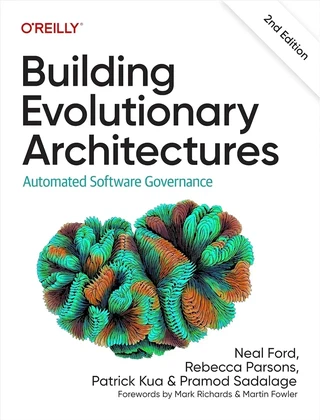
Ford, Parsons, and Kua’s guide to sustainable system evolution through automated governance, fitness functions, and incremental change patterns.
Resources & Links
Ford, Parsons, and Kua teach you to protect critical architecture through automated fitness functions while enabling continuous evolution—architecture becomes a living system, not a static blueprint.
Who This Is For
Software architects responsible for system longevity. Platform engineers building infrastructure that must evolve safely. DevOps practitioners implementing continuous delivery. Technical leads guiding teams through monolith-to-microservices transitions. Anyone maintaining systems that must adapt to changing requirements without breaking.
Key Takeaways
- Fitness Function Implementation: define automated tests that validate architectural characteristics (performance, security, scalability). Create measurable assertions like “API response time <200ms at p99” or “deployment pipeline completes in <15 minutes.” Integrate into CI/CD pipelines.
- Incremental Change Engineering: break large architectural changes into small, deployable increments using patterns like Branch by Abstraction, Parallel Change, and Feature Toggles. Each change must maintain system functionality while moving toward target architecture.
- Architectural Coupling Analysis: use tools (ArchUnit, Fitness Functions, dependency analyzers) to detect and prevent unwanted coupling between components. Establish coupling budgets that automatically fail builds when violated, preventing architectural erosion.
- Evolutionary Database Techniques: implement database migrations as code (Flyway, Liquibase) enabling schema evolution alongside application code. Create backward-compatible changes allowing zero-downtime deployments. Track database changes with same rigor as application code.
- Topology-Aware Architecture: choose architectural styles (microservices, event-driven, serverless) based on evolutionary requirements rather than trends. Map business capabilities to service boundaries using Domain-Driven Design. Design for replaceability rather than reusability.
Related Books
More titles with similar themes.
Clean Architecture: A Craftsman's Guide to Software Structure and Design
Uncle Bob reveals timeless architecture rules that eliminate framework dependencies, maximize testability, and enable systems to evolve gracefully across decades.
By Robert C. Martin
Domain-Driven Design: Tackling Complexity in the Heart of Software
The foundational text teaching platform architects to model complex business domains through patterns that unite technical implementation with strategic organizational design.
By Eric Evans
